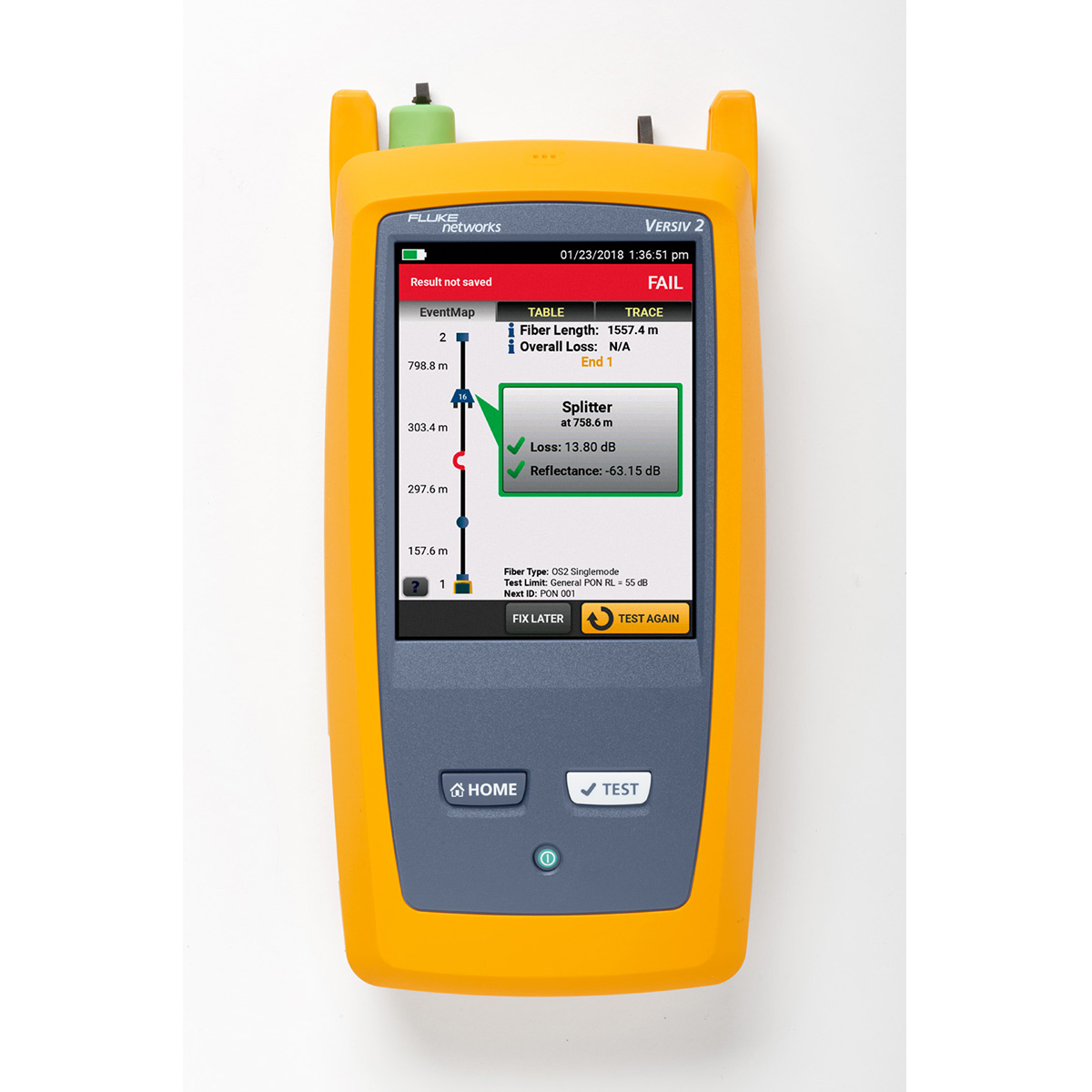
OptiFiber Pro HDR Singlemode OTDR Tester
Designed for Enterprise, Datacenter, Outside Plant and PON Fiber
As fiber networks evolve, the need to test in more locations has increased. OTDRs are now needed for:
• FTTx
• Enterprise
• OSP
• PON
• POLAN
Many OTDRs designed for fiber troubleshooting are designed for carrier and contain cumbersome and complicated features. The OptiFiber Pro OTDR family is the first class of OTDRs that is built with features and usability for both the enterprise network engineers, and cable installers working in both enterprise and OSP environments.
Documents:
Key Features
- Extremely short event and attenuation dead zone for the Enterprise
- Two second trace per wavelength
- On-screen help – corrective action
- SmartLoop OTDR
- Fiber Endface Inspection and Certification
OptiFiber Pro HDR has a dynamic range up to 42 dB and adds new wavelengths for outside plant/FTTx/PON testing requirements. Three wavelength combinations are available depending upon your requirements.
• 1310/1550 nm• 1310/1490/1550 nm
• 1310/1550/1625 nm
Most OTDRs are designed for a myriad of applications, causing the user interface to be difficult to navigate and interpret. OptiFiber Pro combines the latest “gesture-based” interface technology with a capacitive touchscreen to deliver the most innovative and user-friendly OTDR.
Advantages:• Single-touch tap and swipe control for selecting and scrolling menu items
• Multi-touch pinch to zoom for easy magnification control on a graphical fiber trace
• Task-focused design to reduce back and forth navigation through screens
• Capacitive touchscreen eliminates the need to recalibrate unlike legacy touchscreens
• Context sensitive on-screen help that gives users additional details or problem resolution suggestions
An important aspect in maximizing an OTDR’s value is to properly plan its day-to-day usage. With built-in project management, OptiFiber Pro allows a project manager to define each user’s role, settings and the associated tasks to be performed – transforming the OTDR into an all-in-one fiber testing tool complete with planning, inspection, certification and reporting.
OptiFiber Pro enhances job efficiency by allowing the workflow planner to create and manage operator and job profiles per project - defined jobs or sets of cable IDs can be assigned to specific operators. The progress and status of each project can also be easily monitored.
Advantages:• Full OTDR capability that certifies fiber performance based on job assignment for each operator
• Powerful project management facilitates OTDR sharing with clear job assignment for each operator
• Easy monitoring of job progress with pass/fail results
• On-screen report generation and upload to LinkWare™ application

Leveraging the popular and multi-featured LinkWare cable test management software application, OptiFiber Pro users can easily access the hassle-free project management, report generation, and software upgrade capabilities to manage workflow and consolidate test results.
An important aspect in maximizing an OTDR’s value is to properly plan its day-to-day usage. With ProjX management system, OptiFiber Pro allows a project manager to define each user’s role, settings and the associated tasks to be performed – transforming the OTDR into an all-in-one fiber testing tool complete with planning, inspection, certification and reporting.
Advantages:• Powerful ProjX management system facilitates OTDR sharing with clear job assignment for each operator
• Easy monitoring of job progress with pass/fail or document only results
• Built-in Visual Fault Locator (VFL) to facilitate troubleshooting
• On-screen report generation and upload to LinkWare™ application
• Integrated Wi-Fi allows you to easily upload results to LinkWare™ Live
| OptiFiber Pro Series OTDRs | ||
| OptiFiber Pro | OptiFiber Pro HDR | |
| Models in Series | OFP2-100-M (850, 1300 nm) OFP2-100-S (1310, 1550 nm) OFP2-100-Q (850, 1300, 1310, 1550 nm) | OFP2-200-S (1310, 1550 nm) OFP2-200-S1490 (1310, 1490, 1550 nm) OFP2-200-S1625 (1310, 1550, 1625 nm) |
| Application | Enterprise, Datacenter, Campus | FTTx, Outside Plant, PON, POLAN, Access |
| Wavelengths | 850 nm 1300 nm 1310 nm 1550 nm | 1310 nm 1490 nm 1550 nm 1625 nm |
| Compatible fiber types | 50/125 µm, 62.5 µm, Singlemode | Singlemode |
| OTDR Port Connector | Cleanable UPC ferrule with removable SC adapter | Cleanable APC ferrule with removable SC adapter |
| Supplied Test Cords | Launch Fibers for testing LC systems | 2m TRC for testing SCAPC systems |
| OTDR types | Auto, Datacenter, Manual | Auto, Auto PON, Manual, Manual PON |
| Event Dead Zone | 850 nm: 0.5 m (typical), 1300 nm: 0.7 m (typical), 1310 nm: 0.6 m (typical), 1550 nm: 0.6 m (typical) | 1310 nm: 0.7 m (typical), 1490 nm: 0.7 m (typical), 1550 nm: 0.7 m (typical), 1625 nm: 0.7 m (typical) |
| Attenuation Dead Zone | 850 nm: 2.5 m (typical), 1300 nm: 4.5 m (typical), 1310 nm: 3.6 m (typical), 1550 nm: 3.7 m (typical) | 1310 nm: 4 m (typical), 1490 nm: 4 m (typical), 1550 nm: 4 m (typical), 1625 nm: 4 m (typical) |
| PON Dead Zone | N/A | 30 m (typical) |
| Dynamic Range | 850 nm: 28 dB (typical) 1300 nm: 30 dB (typical) 1310 nm: 32 dB (typical) 1550 nm: 30 dB (typical) | 1310 nm: 42 dB (typical) 1490 nm: 41 dB (typical) 1550 nm: 41 dB (typical) 1625 nm: 40 dB (typical) |
| Reflectance range | 850 nm: -14 dB to -57 dB (typical), 1300 nm: -14 dB to -62 dB (typical), 1310 nm: -14 dB to -65 dB (typical), 1550 nm: -14 dB to -65 dB (typical) | 1310 nm: -14 to -70 dB (typical), 1490 nm: -14 dB to 70 dB (typical), 1550 nm: -14 dB to -70 dB (typical), 1625 nm: -14 dB to -70 dB (typical) |
| Sampling Resolution | Up to 64,000 | Up to 129,000 |
| Expert Manual Mode | Yes | Yes |
| SmartLoop with on-board | Yes | Yes |
| Macrobend detection | Yes | Yes |
| Span Support | Coming early 2019 | |
| Event editing and additions | Coming early 2019 | |
| VFL | Yes | Yes |