


Professional WiFi Survey and Reporting
WiFi Site survey is the most important and critical of WiFi design and must be performed to validate what was intended initially with the design. There are different survey types which are performed in different stages of deploying a wireless network. Each one is undertaken differently but they all complement each other in the common goal of delivering a good robust wireless network.
- Predictive Survey
- Passive Survey
- Active Survey
- Spectrum Analysis Survey
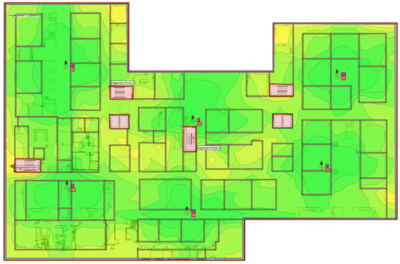
Predictive Survey:
A predictive site survey is performed without any type of field measurements. It uses RF planning software tools that can predict wireless coverage of the APs. To perform this site survey, a floor-plan drawing is a must-have. Predictive site survey or WiFi Planning is done before deployment of APs. For WiFi Design Planning, the general factors considered in each survey include your premises size, the required overage, the number of devices accessing the network (capacity), current infrastructure, interference, and the construction of the building.
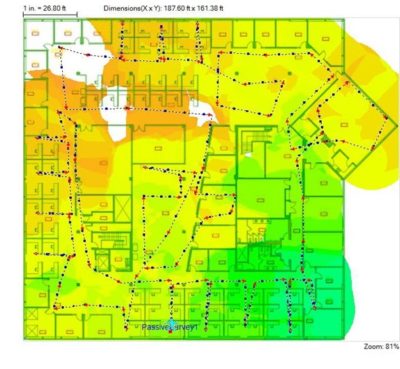
Passive Survey:
A Passive Survey (post-deployment validation survey) is conducted passively and undertaken once the WLAN is operational. A passive site survey tool listens to existing access points and, outside your managed infrastructure, for signal strength, interference, and AP coverage. This information is then mapped to a Received Signal Strength Indicator (RSSI) level on a floor map and displayed in the form of a heat map. It can also show SNR, Noise, and CCI values for comparison with the predictive survey. Passive site surveys, in which surveyed WiFi adapters don’t need to associate to the AP or SSID, give a good overall picture of the RF characteristics of existing wireless networks.
Active Survey:
During an active site survey, the survey WiFi adapter is associated to the AP(s) and exchanges packets. This allows gathering of very detailed information. Actual network traffic, throughput packet loss, jitter, delay and physical (PHY) rates can be captured. Active surveys are commonly used for new WLAN deployments. This survey is very useful where voice over wireless LAN (VoWLAN) services are required.
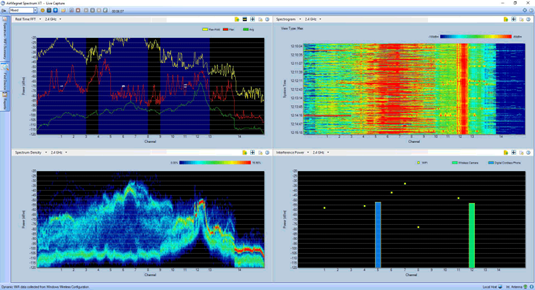
Spectrum Analysis Survey:
One of the key steps that a WLAN engineer can take to improve WiFi performance is to conduct spectrum analysis, which is a method for visualizing the radio frequency in a surveyed area and determining the strength of a signal. In addition to seeing that strength, a spectrum analyzer can find interference that would negatively impact wireless performance. Spectrum analysis will require the use of a special adapter capable of reading not only WiFi signals, but non-WiFi signals as well. Interference is one of the primary contributors to degraded Wi-Fi performance and reliability causing poor connections. Both the 2.4GHz and 5GHz bands suffer from interference. Periodic surveys and spectrum analysis of the scope area are recommended to be undertaken regularly to confirm network health and identify areas of concern.
Our experienced technical engineers will carry out the wireless survey and you’ll receive a full report, which will outline any work required to maximize your network coverage.